Showing posts with label Commercial Health Insurance. Show all posts

Wednesday, 8 July 2015

Three Downsides to Commercial Health Insurer Consolidation

Writing in The Wall Street Journal, Scott Gottlieb argues that the Aetna-Humana and the Anthem-Cigna combinations are evidence of waning insurer competition that is the direct result of Obamacare.  Not only are ACOs not a panacea, but the Affordable Care Act's insurance mandate to limit administrative costs is forcing Aetna et al to spread their costs over a larger base.  Dr. Gottlieb fears that the oligopolies won't be able to deliver on innovation and will limit consumer choice   

Too bad The WSJ didn't give him more print space.  If they did, Dr. Gottlieb may have also pointed to three other potential downsides to commercial insurer consolidation:

1) The concentration of risk: While having a small regional health insurer go bust is a big problem for hundreds of thousands of insurance enrollees, having a for-profit national insurer with tens of millions of enrollees go bust would be a national catastrophe. Think Lehman Brothers, Black Swans and Too Big To Fail.

2) Cronyism: Politicians and C-Suite executives no longer blush at the prevalence of the revolving door between government and all industry.  Health insurance will likewise be too regulated and complicated to leave to anyone other than insiders, who will naturally be unable to discern the line that separates their interests from the patients'.
 
3) Political Power: Will Washington DC and 50 states really be able to stand up to a handful of companies that dominate a fifth of the national economy?  Years ago, the commercial insurers remained silent while they were called "Fat Cats." The Population Health Blog bets that the next time a While House blames the insurers for rising costs, they won't remain so deferential.

Image from Wikipedia

Tuesday, 28 April 2015

For the Commercial Health Insurers, Winter Is Coming

Fans of HBO's hit fantasy TV series Game of Thrones will recognize the adage. 

In the show, the continent of Westeros has had a long hot summer of breasts, butts and beheadings. Now, it's not only getting colder, but there have been sightings in the North of blue-eyed freeze-dried warrior zombies. Crops are failing, the northern tribes are fleeing and the crows are looking more sinister by the minute. The only thing that separates civilization from catastrophe is The Wall.  That's made of a lot of ice and it is guarded by the Night's Watch.  The Watch is made up of mostly unsavory criminal types who have been given the choices of decapitation or taking The Oath.  Think of them as the Fence Frozen Legion.  Cue camera, raise swords... action!

Naturally, the Population Health Blog is enjoying every minute of it, and so is, inexplicably, the PHB Spouse.  We're both gained valuable insights.  While the PHB ponders her observation that men are untrustworthy swine, it has more constructively responded that Game of Thrones has many lessons that speak to the health insurance market.

To wit:

The Night's Watch may be made up of villains, but they're our villains and they're performing a valuable function.  Commercial health insurers likewise have their knaves, but for years they have been pooling risk and paying claims. 

Unfortunately, times are changing. While we've had a lusty summer of low cost inflation and innovation, Accountable Care Organizations are not as successful as hoped, insurer networks have gone skinny, out-of-pocket expenses are climbing and tax bills are coming due.  While we thought the undead "Medicare for All" was just an unpleasant memory, there have been sightings here and here

Will the Night's Watch of commercial insurers hold the wall?  Cue camera, raise swords.... action!

Image from Wikipedia

Monday, 26 May 2014

The Two-Sided Iron Triangle of Cost and Access and What It Means for Health Reform in 2015

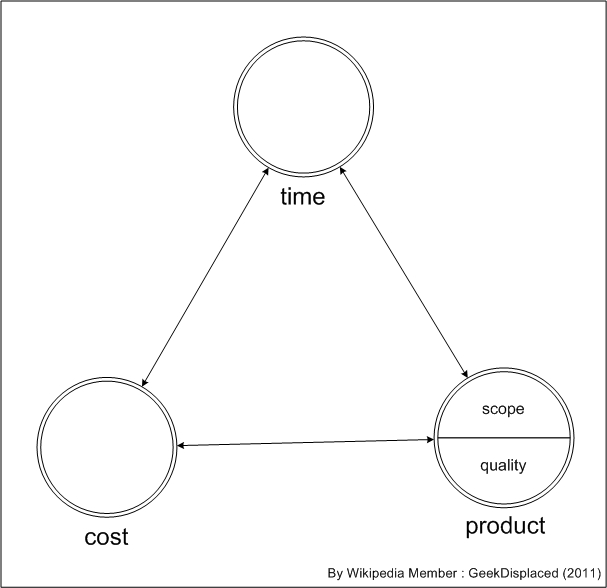
From time to time, the Population Health Blog likes to refer to this article on the "iron triangle" of health care reform. Using classic project management theory, it suggests health care planning is:

a) bound by 1) cost, 2) quality and 3) access, and

b) if there are limited resources, health system planners can only optimize two out of three.

Want to decrease costs?  Either quality will go down or access to care will decline. 

Want to increase access?  Docs and operating rooms will spend less time with patients (quality will suffer) or costs will go up, because you have to hire more docs or build more operating rooms.

Suppose you want to increase quality?  Because most interventions that increase quality are not free, it'll cost you.  Alternatively, fixed budgets and resources will have to be tasked to additional needs, so access will suffer.

It's admittedly simplistic, but this framework can be used even by the amateurs in the White House to better define the Veteran Affairs scandal. As the PHB understands it, VA administrators wanted to increase quality (more primary care, better mental health services), but they didn't have the budget to match it. Access declined and, voila, waiting lists developed.

Which brings the PHB to the insurers' dilemma.  The generous narrative is that commercial and government insurers can leverage "quality" and somehow increase access for more persons with insurance and/or "bend the curve" of cost inflation.  The "iron triangle" says that's not true and the PHB agrees.

That's because:

1) while it's possible to statistically assess outcomes in primary care settings, there is a shortage of primary care providers.

2) it's far more difficult to statistically assess outcomes in specialty settings, where there are limited numbers of patients, fewer commonly accepted outcomes and a greater impact of patient variation.

In other words, quality is neutralized. That means health care is a two sided triangle.

Assuming quality is now constant, the PHB now has another reason to predict that insurers will have only two options in 2015:

1) increase access to care for more persons, but that means increasing, not decreasing costs. That means higher out-of-pocket costs for patients, or lower reimbursement for providers.

2) lower costs, but that means decreased access to care. Providers will refuse to contract or more restricted provider networks be created.

Image from Wikipedia

Thursday, 8 May 2014

Over Four Million Dollars to Save a Life?

Enjoy the ride!
Lebron James fan Jason Shafrin of the Healthcare Economist blog hosts the latest edition of the Health Wonk Review.  It's not only fit for a king, it's also fit for any student of health policy that wants unique insights unavailable anywhere else. 

Lots of learning with links can be found here.

The Population Health Blog's recent post on the life-saving attributes of health insurance is included in Jason's Review.  In it, the PHB points out that mandating coverage for 830 persons to save one life is not welcome news.

Docs like the PHB conventionally (and arbitrarily) believe that a reasonable "number needed to treat" (the number of patients that have to be exposed to a treatment in order to achieve a successful outcome) is less than a hundred.  Start going higher than that, and we begin to worry that the treatment may be worse than the disease.

Attach dollars to it and the number becomes even more telling.  Assuming an average health insurance policy "costs" $5000 per year, that's a back-of-the envelope cost of $4.15 million per life saved.  While the PHB would be the first to point out that every life is precious, that falls outside usual assessments of cost-effectiveness.

Bottom line?  These data suggest that we can save lives by mandating insurance, but there is no free ride.

In fact, this one is gold plated.

Image from Wikipedia