Welcome to your latest edition of the Cavalcade of Risk. The Population Health Blog is pleased to offer this linked summary of some of the best and latest bloggery dealing with economic risk.
Knowing how busy readers are, this particular edition wanted to focus on the "bottom line" of each entry. The most important insight is at the end of each paragraph.....
Enjoy!
Auto
Wondering if that non-performing capital assessment called a "parked car" can be addressed by "peer-to-peer car sharing?' Well, if you think you can grab a portion of Hertz's market share by renting that car, you may want to pause and think about what your automobile insurance has to say about it. Hank Stern over at the Insure Blog points out that a wreck may not be covered leaving you personally responsible for another party's injuries....
Workers Comp
Did you know that employers can be arbitrary, hostile and vindictive? That employees can be sullen, suspicious and uncooperative? Toss in a significant job injury, and you've got is what AMAXX Blog writer Michael Stack describes as an unwritten part of a workers compensation adjuster's job description: being a peacemaker. Employees ultimately do better if they get to work sooner rather than later, and bosses do better they step back and let the workers comp adjuster deal with any possibility of malingering....
Data Privacy
After Target and eBay, your company's (or, come to think about it, government's) databases may not only be next, that possibility is greater than you realize. RJ Weiss at the Weiss Insurance Agencies does readers a service by summarizing some of the numbers around the risk of data breaches, including a cost of $195 to $246 per record, an average loss of 2.8% of customers and that having strong preventive measures in place can reduce your cost by $8.98 per record. Important sources of break-ins include those portable devices and sloppy third parties....
Health Insurance
We'd all like to think that hospitals are working hard to reduce costs and increase quality thanks to the government's value-based purchasing initiative. Jason Shafrin of the Healthcare Economist summarizes a recent peer-reviewed publication on the topic and the bottom line answer is "not exactly." While results may be more a function of the baseline that was used, there was no discernible impact on clinical process or patient experience performance for Medicare beneficiaries....
Speaking of payment initiatives, your host's Population Health Blog (PHB) takes a look at another recent scientific publication that examines how a statewide bundled payment program stumbled. The process was stymied by the usual payer-provider tensions, inadequate information technology, regulatory concerns and difficulties on defining just what makes up an "episode of care." It turns out that getting bundled payment off the ground is far harder than it looks....
Getting health insurance between jobs should be easy, but it's not. Louise over the Colorado Health Insurance Insider cuts through the noise of Obamacare and the individual market by offering up some useful insights, including the definition of a "qualifying event," the 60-day rule and the option of using Medicaid to trigger a qualifying event to navigate the 60-day rule....
The next host of the Cavalcade of Risk is Paul Dzielinski. The PHB is looking forward to his hosting debut!
Showing posts with label Medicaid. Show all posts
Showing posts with label Medicaid. Show all posts
Wednesday, 6 August 2014

Monday, 26 May 2014
The Two-Sided Iron Triangle of Cost and Access and What It Means for Health Reform in 2015
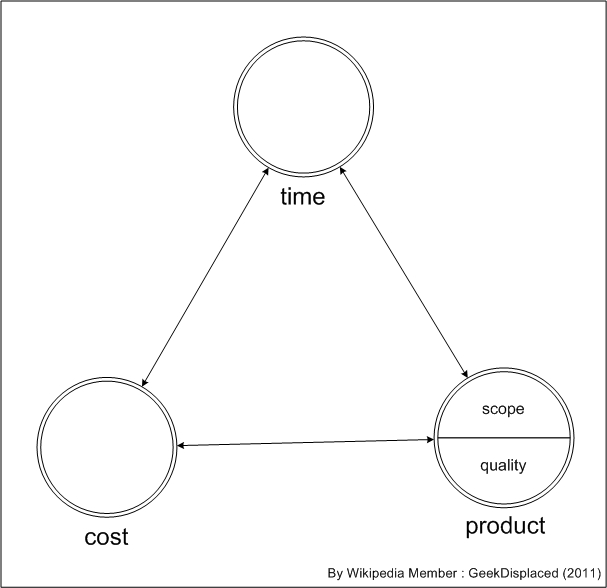 From time to time, the Population Health Blog likes to refer to this article on the "iron triangle" of health care reform. Using classic project management theory, it suggests health care planning is:
 a) bound by 1) cost, 2) quality and 3) access, and
b) if there are limited resources, health system planners can only optimize two out of three.
Want to decrease costs? Either quality will go down or access to care will decline.
Want to increase access? Docs and operating rooms will spend less time with patients (quality will suffer) or costs will go up, because you have to hire more docs or build more operating rooms.
Suppose you want to increase quality? Because most interventions that increase quality are not free, it'll cost you. Alternatively, fixed budgets and resources will have to be tasked to additional needs, so access will suffer.
It's admittedly simplistic, but this framework can be used even by the amateurs in the White House to better define the Veteran Affairs scandal. As the PHB understands it, VA administrators wanted to increase quality (more primary care, better mental health services), but they didn't have the budget to match it. Access declined and, voila, waiting lists developed.
Which brings the PHB to the insurers' dilemma. The generous narrative is that commercial and government insurers can leverage "quality" and somehow increase access for more persons with insurance and/or "bend the curve" of cost inflation. The "iron triangle" says that's not true and the PHB agrees.
That's because:
1) while it's possible to statistically assess outcomes in primary care settings, there is a shortage of primary care providers.
2) it's far more difficult to statistically assess outcomes in specialty settings, where there are limited numbers of patients, fewer commonly accepted outcomes and a greater impact of patient variation.
In other words, quality is neutralized. That means health care is a two sided triangle.
Assuming quality is now constant, the PHB now has another reason to predict that insurers will have only two options in 2015:
1) increase access to care for more persons, but that means increasing, not decreasing costs. That means higher out-of-pocket costs for patients, or lower reimbursement for providers.
2) lower costs, but that means decreased access to care. Providers will refuse to contract or more restricted provider networks be created.
Image from Wikipedia
Subscribe to:
Posts (Atom)